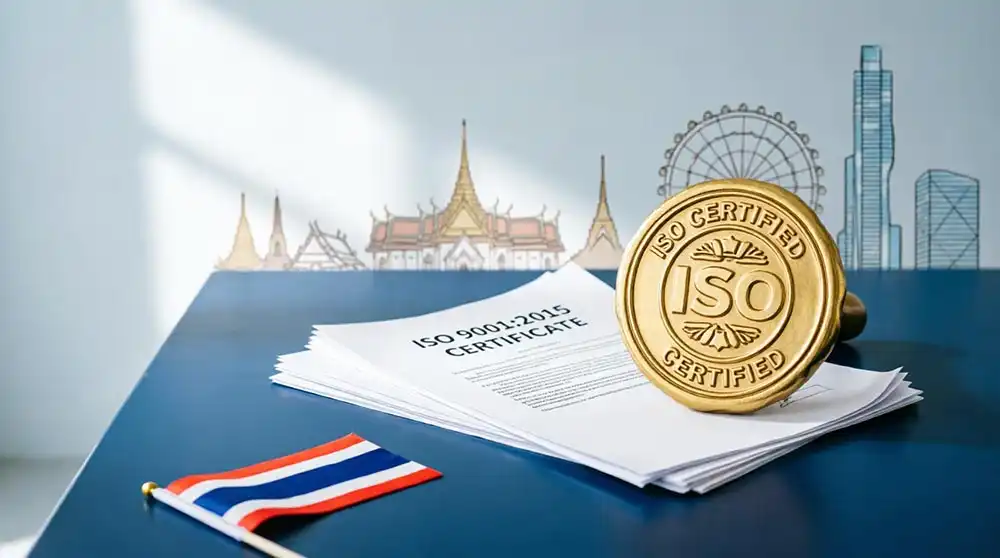
To get ISO certification in Thailand, follow nine simple steps. Pick the right standard. Run a gap analysis. Build your documents. Put the system to work. Train your staff. Run an internal audit. Then pass the final audit by an accredited body. Your certificate stays valid for three years. You renew it with yearly surveillance audits.
Thai businesses compete in a fast-growing market. Factories in Rayong, exporters in Bangkok, and service firms across the country all face one demand. Clients want proof of quality and safety. ISO certification gives them that proof. It shows partners and regulators that your systems meet world standards.
This guide shows you how to get ISO certified in Thailand. You will learn the steps, the timeline, the costs, and the rules. You will also find the best standard for your industry. And you will learn the mistakes to avoid.
Thai ISO, a service by Kingsmen Certification Services, guides Thai firms through every step. Let’s begin.
What Is ISO Certification in Thailand?
ISO certification is proof that your business meets a global standard. These standards come from the International Organization for Standardization (ISO). They cover quality, safety, the environment, food safety, and data security.
In Thailand, an accredited body checks your system and issues the certificate. Many of these bodies work under the Thai Industrial Standards Institute (TISI). TISI is the national accreditation authority.
So how does it work? An auditor looks at how you run your business. They review your processes, documents, and records. They check them against the standard. If you meet the rules, you get the certificate.
Why does this matter? It builds trust. It opens the door to exports, tenders, and bigger deals. It also makes your daily operations run better.
Why Do Companies Need ISO Certification in Thailand?
Thai firms get certified for clear, practical reasons. Here are the most common ones:
- Customer trust: It proves you care about quality.
- Export demand: Many foreign buyers only work with certified suppliers.
- Compliance: It helps you meet legal and industry rules.
- Better quality: Set processes cut errors and waste.
- Business growth: Certified firms win more tenders and markets.
- Stronger teams: Clear roles improve daily work.
For small and medium firms, certification levels the field. It helps you compete with bigger players. It also wins the trust of global clients.
Step-by-Step ISO Certification Process in Thailand
Getting certified follows a clear path. Here are the nine steps from start to finish.
- Choose your ISO standard. Pick the one that fits your industry, like ISO 9001 for quality.
- Run a gap analysis. Compare your current work against the standard’s rules.
- Build your documents. Write the policies, procedures, and records you need.
- Put the system to work. Use your new processes in every department.
- Train your staff. Make sure your team knows the new rules and their roles.
- Run an internal audit. Find and fix gaps before the real audit.
- Hold a management review. Leaders check results and confirm you are ready.
- Pass the certification audit. An accredited body audits your system in two stages.
- Get your certificate. Once you pass, you receive your ISO certificate. It lasts three years.
ISO certification process at a glance
| Step | Activity | Outcome |
| 1 | Choose standard | Right standard selected |
| 2 | Gap analysis | Compliance gaps identified |
| 3 | Documentation | Required documents created |
| 4 | Implementation | System in daily use |
| 5 | Training | Staff aligned and ready |
| 6 | Internal audit | Readiness verified |
| 7 | Management review | Leadership sign-off |
| 8 | Certification audit | Independent assessment passed |
| 9 | Certification | Certificate issued (3 years) |
How Long Does ISO Certification Take in Thailand?
The timeline depends on two things: your company size and how ready you are. Small, organized firms move fast. Large or complex firms need more time.
| Company size | Typical timeline |
| Small business (under 50 staff) | 2 to 4 months |
| Medium business (50–250 staff) | 4 to 6 months |
| Large organization (250+ staff) | 6 to 12 months |
Expert help can speed things up. Good guidance helps you avoid delays, rework, and failed audits.
ISO Certification Requirements in Thailand
To pass your audit, you must show proof. Your system has to meet the standard. Use this checklist to get ready:
- Documented policies: A written quality, safety, or environmental policy.
- Defined procedures: Clear steps for your key tasks.
- Records: Proof that your processes run as written.
- Staff training: Evidence that your team is trained.
- Internal audit reports: Results from your own checks.
- Management commitment: Proof that leaders back the system.
Meeting these rules is easier with the right help. An integrated management system also helps if you plan to combine standards.
How Much Does ISO Certification Cost in Thailand?
The cost is not the same for every firm. There is no fixed price. Several factors shape the final figure:
- Company size: Bigger firms need more audit time.
- Staff numbers: More staff means more training and review.
- Scope: One site costs less than many sites.
- Chosen standard: Complex standards take more work.
- Your readiness: Prepared firms need less consulting time.
- Certification body fees: The body charges for the audit and certificate.
Remember the yearly surveillance audits too. They keep your certificate valid for the full three years. For a real figure, ask us for a quote built around your business.
Which ISO Certification Is Best for Thai Companies?
The best standard depends on your industry and goals. This table compares the top options for Thai firms.
| Standard | Focus area | Best for |
| ISO 9001 | Quality management | All industries |
| ISO 14001 | Environmental management | Manufacturers, factories |
| ISO 45001 | Health and safety | Construction, heavy industry |
| ISO 22000 | Food safety | Food and beverage firms |
| ISO 27001 | Information security | IT and data-driven firms |
| ISO 13485 | Medical device quality | Medical device makers |
| ISO 50001 | Energy management | Energy-intensive operations |
Not sure where to start? Begin with ISO 9001. It builds a strong base and works well with other standards.
Industries That Need ISO Certification in Thailand
Almost every sector in Thailand gains from ISO certification. Here are the industries we support most:
- Manufacturing and trading
- Automotive
- Medical devices
- Construction
- Food, hotels, and restaurants
- Software and IT
- Oil and gas
- Electrical and electronic
- Education
- Transport and logistics
Each sector faces its own risks and rules. The right standard, used well, meets those needs.
ISO Certification vs ISO Training
These two services are linked but different. Knowing the gap helps you plan well.
ISO certification is the process of getting your system audited and approved. The result is an official certificate for your firm.
ISO training builds your team’s skills to run and check that system. For example, lead auditor training prepares staff to lead full audits. internal auditor training prepares them for your in-house checks.
Most firms need both. Training supports certification. And certification rewards good training.
Common Mistakes During ISO Certification
Many Thai firms hit problems they could avoid. Watch out for these:
- Treating it as paperwork only. Documents matter, but real use matters more.
- Skipping the gap analysis. This leads to nasty surprises at the audit.
- Weak management support. Without leader buy-in, the system fails.
- Poor staff training. Untrained staff cannot follow new rules.
- Rushing the timeline. Cutting corners often means a failed audit.
- Ignoring surveillance audits. Skip these and you can lose your certificate.
Good planning and expert help let you avoid every one of these.
ISO Certification in Major Thailand Locations
We support firms across Thailand’s main business and industrial hubs:
- ISO certification in Bangkok
- ISO certification in Chonburi
- ISO certification in Rayong
- Pathum Thani
- Samut Prakan
- Chiang Mai
- Phuket
- Pattaya
Maybe your firm sits in the Eastern Economic Corridor. Or maybe it sits in central Bangkok. Either way, the process stays the same. Local support just makes it smoother.
Start Your ISO Certification Journey
ISO certification is a smart investment. It boosts your firm’s trust, efficiency, and growth. The process is simple when you follow the right steps. Choose your standard. Build your system. Train your team. Pass your audit.
ISO certification specialists at Thai ISO reviewed this guide. We are part of Kingsmen Certification Services. Our team supports Thai firms with gap analysis, documents, implementation, and audit readiness. We cover every major standard and industry.
Ready to start? Contact the team at Thai ISO for a free consultation and a quote built for your business.
Frequently Asked Questions
What is ISO certification?
ISO certification is proof that your firm meets a global standard. An accredited body audits your processes against that standard. If you pass, you get a certificate valid for three years. You keep it with yearly surveillance audits.
How long does ISO certification take in Thailand?
Most small firms get certified in 2 to 4 months. Medium firms take 4 to 6 months. Large firms may need 6 to 12 months. Your readiness and the standard’s complexity affect the final time.
How much does ISO certification cost in Thailand?
There is no fixed price. The cost depends on your size, staff numbers, scope, standard, and audit fees. Yearly surveillance audits add to the total. Ask us for a quote built around your firm.
Which ISO standard should I choose first?
Most Thai firms start with ISO 9001 for quality. It suits every industry and builds a strong base. You can add standards like ISO 14001 or ISO 45001 later through one combined system.
Who issues ISO certificates in Thailand?
Accredited certification bodies issue the certificates. Many work under the Thai Industrial Standards Institute (TISI), the national authority. The body that certifies you must be separate from the consultant who helps you prepare.
Is ISO certification a one-time process?
No. Your certificate lasts three years. During that time, you pass yearly surveillance audits to keep it active. After three years, you take a recertification audit to renew it.
Can small businesses get ISO certified?
Yes. Certification is open to firms of any size. Many Thai SMEs get certified to build trust, win tenders, and compete with bigger firms. Smaller firms often finish the process faster.
Do I need a consultant to get ISO certified?
A consultant is not required by law, but it helps a lot. Expert guidance cuts delays, prevents rework, and helps you pass on the first try. That saves you time and money.