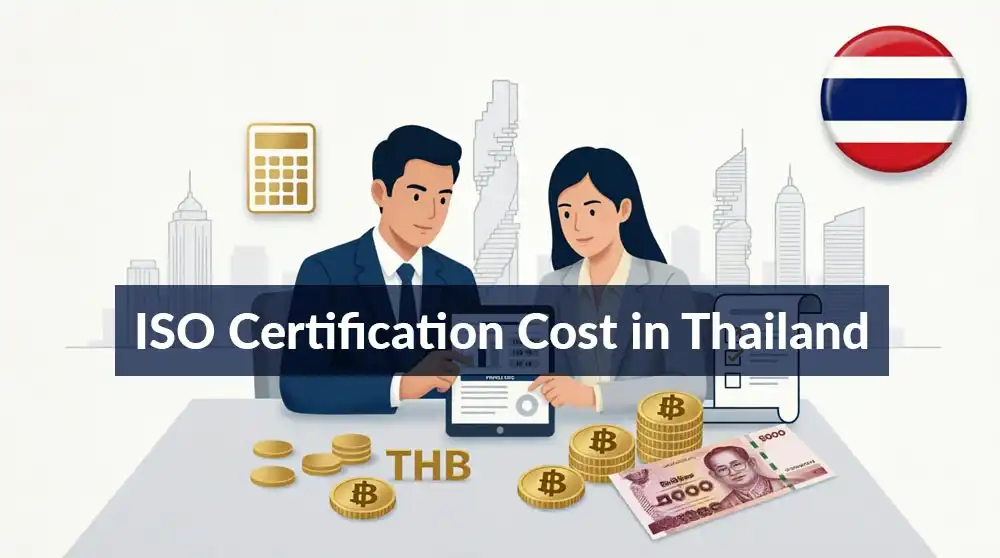
ISO certification cost in Thailand typically ranges from ฿16,000 to ฿35,000+. The final price depends on your company size, the ISO standard you need, and whether you hire a consultant. Main costs include gap analysis, documentation, consultant fees, Stage 1 and Stage 2 audits, and annual surveillance audits.
Planning for ISO Certification in Thailand means knowing what to budget — and why costs differ so much between businesses. A small IT firm pursuing ISO 27001 has a very different budget from a food manufacturer going for ISO 22000. Understanding the cost structure helps you plan with confidence.
This guide covers every major cost component for ISO certification in Thailand in 2026. You’ll find realistic price ranges in Thai Baht, a standard-by-standard comparison, and tips to keep costs under control.
What Determines ISO Certification Cost in Thailand?
ISO certification price in Thailand is not fixed. Several factors affect how much you’ll pay.
- Company size and headcount: Larger companies need more auditor days. More days mean higher certification body fees.
- Number of sites: Each location requires its own audit activity. More sites add to your total ISO audit fees in Thailand.
- Scope of the management system: A narrow scope covering one department costs less than a company-wide system.
- ISO standard selected: Some standards need more documentation. ISO 27001 requires a full risk assessment, which takes more time than ISO 9001.
- Current readiness level: Companies with existing processes spend less on gap analysis. Starting from scratch costs more.
- Use of an ISO consultant: A consultant adds an upfront cost. But they reduce the risk of failing your audit — which costs even more to fix.
ISO Certification Cost Breakdown
The table below shows the main cost components for ISO certification in Thailand. Ranges are indicative. Your actual cost depends on your scope and chosen certification body.
| Cost Component | What It Covers | Typical Range (THB) |
| Gap Analysis | Review of your current systems vs. ISO requirements | ฿15,000 – ฿35,000 |
| Documentation Development | Policies, procedures, and records the standard requires | ฿20,000 – ฿80,000 |
| Consultant Fees (Implementation) | Expert support throughout the implementation process | ฿40,000 – ฿150,000 |
| Training Costs | Staff awareness and internal auditor training | ฿10,000 – ฿40,000 |
| Stage 1 Audit (Documentation Review) | Initial review by the certification body | ฿15,000 – ฿40,000 |
| Stage 2 Audit (Certification Audit) | On-site audit to confirm your system is ready | ฿25,000 – ฿80,000 |
| Annual Surveillance Audit | Yearly audit to keep your certification active | ฿20,000 – ฿60,000 |
| Recertification Audit (Year 3) | Full re-audit at the end of the 3-year cycle | ฿25,000 – ฿75,000 |
Note: These are indicative ranges only. Your actual ISO certification price in Thailand will vary based on company size, scope, number of sites, and your chosen certification body.
ISO 9001 Certification Cost vs. Other Standards
ISO 9001 cost in Thailand is the lowest starting point among the major ISO standards. ISO 9001 is well-known, widely used, and applies to quality management across most sectors. That makes it easier — and cheaper — to implement.
More complex or specialized standards cost more. The table below shows the relative cost tier for the most popular standards in Thailand.
| ISO Standard | Focus Area | Relative Cost Tier | Why It Costs More |
| ISO 9001 | Quality Management | ฿ (Base) | Wide applicability, well-structured requirements |
| ISO 14001 | Environmental Management | ฿฿ | Requires environmental aspect analysis |
| ISO 45001 | Occupational Health & Safety | ฿฿ | Workplace risk assessment adds steps |
| ISO 22000 | Food Safety Management | ฿฿฿ | HACCP plans and food chain traceability |
| ISO 27001 | Information Security | ฿฿฿ | Full risk assessment and 93 controls required |
If you’re new to ISO, start with ISO 9001 certification. It builds a strong foundation. Adding ISO 14001 or ISO 45001 later becomes faster and more affordable.
ISO Certification Cost for Small Businesses in Thailand
The cost of ISO certification for small businesses in Thailand is much lower than for large companies. Certification body fees are based on employee headcount and operational complexity. A company with fewer than 50 staff at one site pays far less than a 500-person manufacturer.
For a small or medium Thai business pursuing ISO 9001 with consultant support, expect to pay ฿16,000 to ฿200,000. This covers gap analysis, documentation, implementation, and both audit stages.
For ISO 27001, the cost for a small business is higher — typically ฿16,000 to ฿350,000. The risk management framework is more complex, which takes more time.
These figures assume single-site operations with some existing documentation. If your documentation is limited, plan for the higher end.
How to Reduce ISO Certification Costs Without Cutting Corners
You can lower your ISO certification cost in Thailand without skipping important steps. Be strategic from the start.
- Prepare documentation before hiring a consultant: The more your team knows upfront, the less time your consultant spends on basics. Less time means lower fees.
- Start with a narrow certification scope: Certify one department first. Expand the scope at your next surveillance or recertification audit.
- Combine multiple standards in one audit: Pursuing ISO 9001 and ISO 14001 together? An integrated audit costs less than two separate ones.
- Fix gaps before your Stage 2 audit: If Stage 1 reveals documentation issues, address them quickly. Delays and rescheduling cost extra.
- Choose a consultant with Thailand experience: A local consultant knows Thai industry norms and preferred certification bodies. That saves time and money.
Consultant Fees vs. Certification Body Fees: What's the Difference?
Many businesses confuse ISO certification consultant fees in Thailand with certification body fees. These are two separate costs, paid to two separate parties.
Consultant fees cover the support you get from an ISO consulting firm. Your consultant helps with requirements, documentation, staff training, internal audits, and audit preparation. Fees vary based on the consultant’s experience and your project scope.
Certification body fees go to an accredited third party — such as BSI, SGS, or Bureau Veritas — that conducts Stage 1 and Stage 2 audits and issues your certificate. Only accredited bodies can issue valid ISO certificates.
You need both. The consultant helps you meet the standard. The certification body confirms that you do.
Get a Clear Cost Estimate for Your Business
Knowing your ISO certification costs is the first step. The next is getting a quote for your specific situation.
Thai ISO Certification works in association with Kingsmen Certification Services to support businesses across Thailand. We offer structured consulting that makes certification efficient and affordable. Contact us today for a free, no-obligation cost estimate.
Frequently Asked Questions
How much does ISO 9001 certification cost in Thailand in 2026?
ISO 9001 cost in Thailand for a small to mid-sized company typically ranges from ฿80,000 to ฿250,000 for the full first year. This includes consultant support, documentation, and both audit stages. Larger companies or multi-site operations pay more. After certification, annual surveillance audits cost ฿20,000 to ฿60,000 per year.
What is the average cost of ISO 27001 certification in Thailand?
ISO 27001 certification in Thailand costs between ฿16,000 and ฿500,000 in the first year. The higher cost reflects the standard’s complexity. Organizations must complete a full information security risk assessment and apply controls across people, processes, and technology. Smaller IT firms with a limited scope can certify closer to the lower end.
What ISO audit fees should a Thai business expect?
ISO audit fees in Thailand cover the Stage 1 documentation review and Stage 2 on-site audit. For a small company, Stage 1 costs ฿15,000–฿40,000 and Stage 2 costs ฿25,000–฿80,000. You pay these fees directly to your certification body. The exact amount depends on company size, number of sites, and the standard you’re pursuing.
Is ISO certification mandatory in Thailand?
ISO certification is voluntary in most cases. However, some industries — such as food production, medical devices, and government contracting — may require it. Many Thai businesses also pursue certification to meet the demands of international clients and export partners.
How long does it take to get ISO certified in Thailand?
Most Thai businesses achieve initial ISO certification within 2 to 4 months. Timelines depend on your existing documentation, the standard’s complexity, and how fast your team addresses gaps. An experienced consultant can shorten this timeline noticeably.
Can a small business afford ISO certification in Thailand?
Yes. The cost of ISO certification for small businesses in Thailand scales with company size. Audit fees are lower for smaller teams. Many SMEs complete ISO 9001 certification for under ฿200,000 in total first-year costs. The benefits — better contracts, stronger client trust, and improved processes — make it a worthwhile investment.