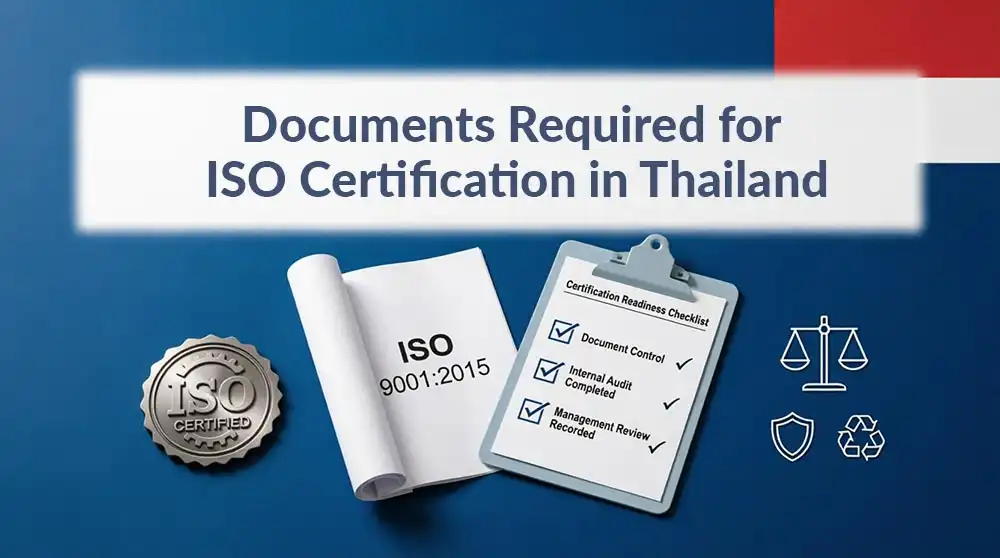
ISO certification in Thailand requires six core document categories: a quality policy, a scope document, quality objectives, procedures and work instructions, mandatory records, and a risk register. The exact list depends on your ISO standard and company size. Having the right documents ready before your audit prevents delays.
Missing a required record can stall your audit. Too many unnecessary documents create extra work. This checklist tells you exactly what you need — nothing more, nothing less.
Thai ISO Certification works in association with Kingsmen Certification Services to help Thai businesses build audit-ready documentation. This article supports our main guide to ISO Certification in Thailand.
Why Documentation Matters in ISO Certification
Documentation is not just paperwork. It is proof that your system works.
Auditors cannot watch every process your team runs. What they review are your records, procedures, and policies. These show your Quality Management System (QMS) is real and active.
ISO 9001:2015 uses the term “documented information.” You can use written procedures, flowcharts, or digital records. But flexibility does not mean optional. Some documents are still mandatory. Missing them causes a non-conformity at your audit.
Good documentation also helps day-to-day operations. It keeps your team consistent, cuts errors, and makes onboarding much easier.
Core Documents Required for ISO Certification
| Document Type | Purpose | Example |
| Quality Policy | States your commitment to quality | “We deliver services that meet customer requirements.” |
| Scope Document | Defines what your QMS covers | Sites, products, and services in scope |
| Quality Objectives | Sets measurable targets | “Reduce complaints by 20% in 12 months” |
| Procedures | Explains how key processes must run | Audit procedure, supplier evaluation |
| Work Instructions | Gives step-by-step task guidance | Assembly checklist, inspection protocol |
| Records / Forms | Proves activities happened | Training logs, signed checklists |
| Risk Register | Lists risks and controls | Risk matrix with mitigation actions |
| Internal Audit Reports | Proves audits were completed | Audit schedule, findings, action items |
| Management Review Minutes | Shows leadership reviewed the QMS | Meeting notes with decisions and actions |
| Corrective Action Log | Tracks issues and fixes | Non-conformance reports, CAPA records |
These are the mandatory documents for ISO certification that auditors check during any ISO 9001:2015 assessment. Other standards may need more. ISO 14001 needs an environmental aspects register. ISO 45001 needs hazard identification records.
Document Checklist by Company Size
Do small businesses need the same documents as large companies? No. ISO 9001:2015 states that documentation should match your organization’s size and complexity.
ISO Certification Document Checklist for Small Business
A small business typically needs this minimum set:
- Quality policy (clause 5.2)
- Scope of the QMS (clause 4.3)
- Quality objectives (clause 6.2)
- Supplier evaluation criteria (clause 8.4.1)
- Training and competence records (clause 7.2)
- Internal audit program and results (clause 9.2)
- Management review minutes (clause 9.3)
- Corrective action records (clause 10.2)
These eight items do not need to be complex. A one-page quality policy works. A short scope statement is fine. They just need to reflect how your business actually runs.
Mid-to-Large Business: Additional Documents
Larger organizations need a broader set of ISO documentation requirements, including:
- Full procedures library for all major processes
- Work instructions for each operational task
- Risk register with identified risks and controls
- Customer satisfaction monitoring records
- Supplier evaluation and performance records
- Calibration records for measurement equipment
- Design and development records (where applicable)
- Production and service provision records
- Change control records
The rule is simple: document what you do, and do what you document. Auditors check whether your documents match your real operations — not how impressive they look.
What Is a Quality Manual and Do You Still Need One?
A quality manual describes your QMS — its scope, policies, and key procedures. Under ISO 9001:2008, it was required. Under ISO 9001:2015, it is not.
The 2015 revision dropped this rule. The goal was to cut unnecessary paperwork and give organizations more freedom.
Many Thai businesses still keep a quality manual. Here is why:
- Client requirements: Some customers ask for one during supplier checks.
- Staff onboarding: It gives new employees a clear overview of the QMS.
- Internal reference: It combines your four core mandatory documents in one place.
If your clients need a quality manual, create one. If they do not, you have no ISO obligation to produce it. What matters is that your documents show your QMS is structured and active.
How Long Should You Keep ISO Records?
ISO 9001:2015 does not set exact retention periods. Your organization must define its own rules and document them.
All retained records must be:
- Legible and clearly identifiable
- Retrievable when auditors or your team need them
- Protected from loss or unauthorized access
When setting your document retention period, consider:
- Legal requirements in Thailand or your jurisdiction
- Customer contracts — some sectors require 10 years or more
- Sector-specific standards — ISO 13485 has its own retention rules
- Your risk level — higher-risk organizations often keep records longer
For most Thai SMEs, standard practice looks like this:
- Audit and management review records: 3–5 years
- Training and competence records: Duration of employment, plus a set buffer
- Corrective action records: 3–10 years, based on contract terms
- Calibration records: Equipment life, plus an investigation window
Create a simple retention schedule. List each record type, how long to keep it, where it is stored, and who owns it. Keep that schedule under document control too.
Common Documentation Mistakes That Delay Certification
Poor documentation is the top reason ISO timelines run over. These are the mistakes auditors catch most often:
- Documents don’t match real practice. If your procedure says one thing and your team does another, the auditor will catch it.
- Training records are missing. Auditors always ask for proof of training. Gaps lead to a non-conformity.
- Internal audits were skipped. They are mandatory. Skip them and you arrive at your external audit unprepared.
- No version control. Without clear version numbers, old documents create compliance gaps.
- Corrective action logs are too thin. Very few logged issues is a red flag. A healthy QMS finds and records problems regularly.
- Over-documentation. Unnecessary procedures make your system hard to maintain. Keep it lean.
Building documentation for the first time? Reviewing an existing QMS? Thai ISO Certification can help you find gaps and fix them. Learn more about how to get ISO certification in Thailand. Or explore our Integrated Management System services if you are pursuing more than one standard.
Start Your Documentation with Expert Support
Getting your documentation right from the start saves time and cuts audit stress. The requirements are not as complex as they look — especially with the right support.
Thai ISO Certification works in association with Kingsmen Certification Services to help businesses across Thailand build audit-ready documentation for ISO 9001, ISO 14001, ISO 45001, and other recognized standards.
Ready to get started? Reach out for a free consultation or documentation support quote:
Frequently Asked Questions
What documents are required for ISO 9001 certification?
ISO 9001:2015 requires four core documents: your QMS scope, quality policy, quality objectives, and supplier evaluation criteria. You also need records for training, internal audits, management reviews, and corrective actions. The total number of records depends on your business size and how your processes work.
Do small businesses need the same documents as large companies?
No. ISO 9001:2015 lets you scale documentation to your size. Small businesses usually need a quality policy, scope statement, training records, audit results, and a corrective action log. Larger organizations need more — such as full procedures, work instructions, and a risk register.
Is a quality manual mandatory for ISO certification?
No. ISO 9001:2015 removed this requirement. Some clients still ask for one. If yours do, create it. If not, skip it. What matters is that your documents show your QMS is real and active.
How long should ISO records be kept?
ISO 9001:2015 does not set fixed periods. You define your own schedule. Base it on Thai laws, customer contracts, and sector rules. Most Thai SMEs keep audit and review records for 3–5 years. Keep training and corrective action records longer if your contracts require it.
Can a consultant help prepare ISO documentation in Thailand?
Yes. A consultant identifies what is missing, aligns your procedures with how your business works, and builds your full document set for audit. Thai ISO Certification — working in association with Kingsmen Certification Services — guides you through every step. This saves time and reduces your audit risk.
What happens if documentation does not match actual processes during an audit?
The auditor records it as a non-conformity. A major finding means you cannot be certified until it is resolved. A minor finding must also be fixed before certification is confirmed. Most organizations have up to three months to correct the issue and provide proof of the fix.