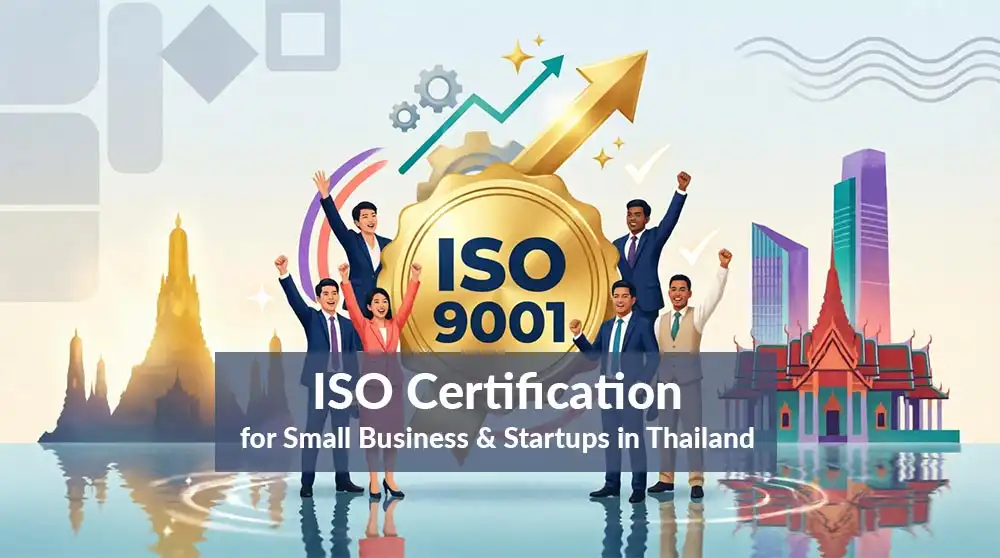
Small businesses and startups in Thailand can get ISO certified. ISO 9001 is the best place to start. It fits small teams and tight budgets. Most businesses finish in 3 to 6 months. Once certified, you can win bigger clients, apply for tenders, build trust with investors, and run your business with stronger systems from day one.
Many Thai startup founders think ISO certification is only for big companies. That’s not true — and that belief has cost some businesses real contracts. ISO certification for small businesses in Thailand is fully possible. It’s also one of the smartest early moves you can make as a growing business. This guide explains what ISO certification means for SMEs and startups. It covers which standard to start with. And it shows how Kingsmen Certification Services makes the whole process simple from day one.
Want the full picture? Visit our main ISO certification in Thailand page.
Can a Small Business Get ISO Certified in Thailand?
Is ISO Certification Worth It for a Startup?
ISO certification for startups in Thailand delivers concrete, measurable advantages. Here are four that matter most at the early growth stage:
- Winning your first major client. Many corporate buyers and international partners require ISO certification before signing contracts. A certified startup removes that barrier immediately.
- Tender eligibility. Government and large private-sector tenders in Thailand often list ISO certification as a mandatory requirement. Without it, your bid does not qualify.
- Investor confidence. ISO certification proves that your startup has documented processes and operational discipline. Investors view this as a sign of scalable, low-risk growth.
- Structured internal growth. Certification forces you to define roles, document workflows, and track performance. These habits prevent costly errors as you scale.
The return on a small business ISO certification cost is not theoretical. It shows up in contracts won, audits passed, and partnerships secured.
How ISO Certification Works Differently for Small Businesses
Large corporations and small businesses both achieve the same ISO certificate. The path looks different depending on company size.
| Area | Startup / SME Approach | Large Company Approach |
| Documentation | Lean documentation focused on core processes | Extensive documentation across multiple departments |
| Timeline | Typically 3–6 months | Often 6–14 months |
| Cost | Lower investment due to smaller scope | Higher cost reflecting complexity and headcount |
| Team Involvement | Whole team participates across all functions | Dedicated quality department manages the process |
For a startup or SME, this means the certification process is faster and more focused. You do not need a dedicated quality manager. You do not need a complex documentation library from day one.
Kingsmen Certification Services fits the process to your team size and stage of growth. Want to see what a guided process looks like? Read more about how to get ISO certification in Thailand.
What Is the Best ISO Standard to Start With as a Small Business?
The right first standard for most Thai SMEs and startups is ISO 9001 certification.
ISO 9001 is the world’s most widely adopted quality management standard. Over 1 million organizations globally held ISO 9001 certification as of December 31, 2022, according to ISO’s own survey data. Here is why it suits small businesses best:
- It applies to any industry. Manufacturing, services, logistics, IT — ISO 9001 fits all of them.
- It focuses on quality and consistency. These are concerns every business shares, regardless of size.
- It is the standard clients recognize. When buyers ask for ISO certification, they usually mean ISO 9001.
- It creates a foundation for other standards. ISO 14001, ISO 45001, and ISO 27001 all build logically on an ISO 9001 base.
- It uses a simplified quality system. The documentation burden scales down for small teams.
If you run a small manufacturing business in Thailand, start with ISO 9001. It covers the three things buyers check most: process control, product consistency, and customer satisfaction.
Common Concerns Small Business Owners Have About ISO Certification
These objections come up in almost every initial conversation. Each one has a clear, practical answer.
- “It’s too expensive for a startup.” Small business ISO certification cost scales with company size. A startup pays significantly less than a large corporation. The investment is proportional to your scope.
- “There’s too much paperwork.” Lean documentation is a core principle of modern ISO 9001. You document what your business actually does — not endless procedures that nobody follows.
- “The standard is too complex to understand.” Kingsmen Certification Services translates every ISO requirement into plain language. You always know what is needed and why.
- “We don’t have a dedicated quality team.” You do not need one. Small businesses assign ISO responsibilities across existing staff. The system fits your structure.
- “We don’t know where to start.” That’s what we’re here for. Kingsmen Certification Services takes care of everything — from the first gap analysis all the way to your final audit.
Want to know what paperwork you’ll need? Check out our guide on documents required for ISO certification. It shows you exactly what to prepare before you start.
Steps to Get Started as a Small Business
Getting ISO certified as a Thai startup or SME follows a clear, repeatable sequence. Here is what the process looks like in practice:
- Gap analysis. A consultant reviews your current operations. This identifies what already meets ISO requirements and what needs adjustment.
- Documentation development. You build the required records, procedures, and quality policies. Kingsmen Certification Services provides templates and guidance throughout.
- Implementation. Your team puts the documented system into practice. This phase builds the habits that make certification real, not just on paper.
- Internal audit. An internal review checks that your system is working as documented. It surfaces any gaps before the external audit.
- Certification audit. An accredited certification body conducts the final audit. Passing this audit earns your ISO certificate, which is valid for three years, subject to annual surveillance audits.
The full process for most Thai SMEs takes between three and six months. Preparation quality directly affects speed.
Ready to Get Your Business ISO Certified?
Frequently Asked Questions
Can a small business get ISO certified in Thailand?
Yes. Any business in Thailand can get ISO certified—big or small. Even a startup with just a few people can qualify. Most small businesses begin with ISO 9001. It helps you look professional, win bigger clients, and build solid systems early on.
Is ISO certification too expensive for startups?
No. It costs less than most people think. The price depends on how big your business is and how complex your processes are. A small startup will pay much less than a large company. Kingsmen Certification Services is upfront about pricing—no surprises, no hidden fees.
How long does it take a small business to get ISO certified in Thailand?
Most small businesses finish in 3 to 6 months. It depends on how ready your team is. If your processes are already organised, it goes faster. Working with Kingsmen Certification Services helps you avoid delays and stay on track.
Do startups need a dedicated quality team for ISO certification?
No. You don’t need a separate quality team. Your current staff can handle it. One person can take the lead, and others chip in where needed. Kingsmen Certification Services will guide your team every step of the way, so no one is left guessing.
Which ISO standard should a small business start with in Thailand?
Start with ISO 9001. It works for any industry and any size of business. It’s the most widely known standard, and it’s a great base to build on later. Once you have ISO 9001, adding other standards like ISO 14001 or ISO 45001 becomes much easier.
Does ISO certification help a startup win investors or funding in Thailand?
Yes. Investors want to see that your business is organised and runs properly. ISO certification shows them exactly that. It proves you have real systems in place—not just ideas. That kind of proof builds trust. It can make a real difference when you’re pitching for funding or looking for your first big partner.