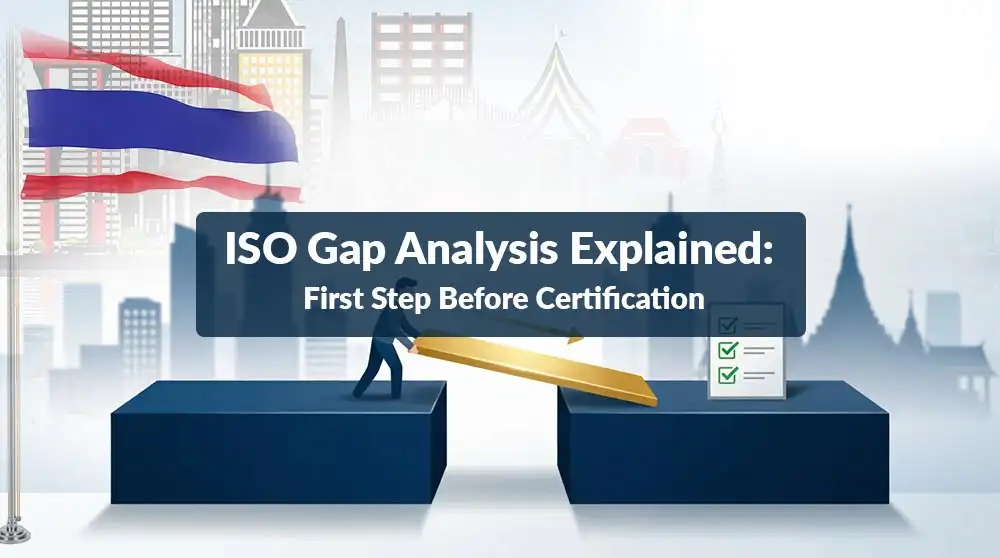
An ISO gap analysis checks your current processes against ISO requirements. It finds the gaps before you start the certification process. Most businesses finish one in one to four weeks. It is always the first step before pursuing ISO certification in Thailand.
Many businesses jump straight in. They write policies. They form teams. They book audits. Then they fail — because no one checked what was missing first.
An ISO gap analysis stops that from happening. It shows you where you stand right now. It compares your current processes to the ISO standard you want. It tells you what needs fixing before you begin.
This guide covers what a gap analysis is and why it matters. You will also find a checklist for small businesses, a look at typical costs, and answers to common questions.
What Is an ISO Gap Analysis?
An ISO gap analysis is a pre-certification check. It compares what your business does now against what the ISO standard requires.
You find out what already works. You also find out what falls short. The shortfalls are your gaps.
An ISO 9001 gap analysis, for example, looks at your quality processes. It checks if your procedures, records, and roles match what ISO 9001 expects. Where they do not, you have a compliance gap.
The result is a gap analysis report. It becomes your improvement plan. It tells you what to fix before your certification audit.
You may also hear this called a baseline audit, a readiness assessment, or a current state assessment. They all mean the same thing.
Why Gap Analysis Comes Before Everything Else
A gap analysis before ISO certification is the smartest place to start. Here is why:
- It avoids wasted work. Without a baseline audit, you may write documents you do not need — or miss ones you do.
- It sets a real timeline. You can plan properly once you know your system maturity level.
- It lowers costs. Fixing gaps early is far cheaper than fixing them after a failed audit.
- It boosts your audit score. Certification bodies want to see structured readiness. A gap analysis shows you are prepared.
- It helps leaders decide. Management can approve budgets when they see a clear improvement plan — not just guesses.
What Happens During an ISO Gap Analysis?
The process is structured and straightforward. Kingsmen Certification Services follows these steps:
| Step | What It Involves |
| Document Review | Current policies, procedures, and records are checked against ISO requirements. Missing or outdated items are flagged. |
| Process Observation | Key processes are watched in action. The consultant checks if real workflows match written procedures. |
| Staff Interviews | Employees and managers are interviewed. This confirms role clarity and system awareness across the team. |
| Comparison Against Standard | Each clause of the ISO standard is checked against your systems. Compliant areas are noted. Gaps are recorded. |
| Gap Analysis Report | A full report is produced. It lists findings, ranks gaps by severity, and outlines a clear improvement plan. |
The time needed depends on your size and the standard being assessed. Small businesses often finish in one to two days. Larger businesses may need more time on-site.
What's Included in a Gap Analysis Report?
A good gap analysis report does more than list problems. It gives you a clear path forward. Here is what it covers:
- Summary — a simple overview of your current compliance status
- Clause-by-clause review — each ISO requirement rated as met, partly met, or not met
- Compliance gaps — areas where your processes fall short
- Risk ratings — gaps ranked from critical to minor
- Recommended actions — steps to close each gap before certification
- Document gaps — missing or incomplete documents you will need (see: Documents Required for ISO Certification)
- Estimated timeline — a schedule for closing gaps and reaching audit readiness
- Improvement plan — next steps organized by team or function
This report guides your whole certification project. Kingsmen Certification Services delivers it in a clear, easy-to-use format.
How Much Does an ISO Gap Analysis Cost?
There is no fixed price. The cost of a gap analysis before ISO certification depends on several things.
Factors that affect the price:- Company size — larger businesses need more time to assess
- Number of staff — more people means more interviews and wider reviews
- Number of sites — multi-location businesses cost more than single-site ones
- ISO standard chosen — complex standards like ISO 27001 need deeper review
- Current system maturity — stronger systems take less time to assess
For small businesses in Thailand, gap analysis is often more affordable than expected. It also costs far less than failing a certification audit.
Kingsmen Certification Services offers custom pricing based on your size, scope, and chosen standard. Contact the team for a clear, honest quote.
ISO Gap Analysis Checklist for Small Businesses
Not sure where to start? Run through this checklist before your gap analysis. It works for most standards, including ISO 9001, ISO 14001, and ISO 45001.
- ☐ Pick your ISO standard — confirm which one fits your industry and goals
- ☐ Map your key processes — list what your business does and who is responsible
- ☐ Gather your documents — collect current policies, procedures, and records in one place
- ☐ Check your management policy — confirm it is written, approved, and shared with staff
- ☐ Review training records — check that staff training is recorded and current
- ☐ Look at your record-keeping — confirm records are stored, organized, and easy to find
- ☐ Check for internal audits — find out if any have been done and when
- ☐ Review past issues — check if past problems were recorded and fixed
- ☐ Confirm leadership involvement — make sure management reviews system performance
- ☐ Note any obvious gaps — write down areas you already know need work
This checklist helps you prepare. But it does not replace a professional gap analysis. A trained consultant will catch gaps your team may miss. For a full pre-certification checklist, visit the ISO Certification Checklist from Kingsmen Certification Services.
Also read the guide on How to Get ISO Certification in Thailand to see the full process.
Ready to Start? Talk to Kingsmen Certification Services
A gap analysis is the best first step you can take. It removes guesswork. It lowers risk. It gives you a clear path to ISO certification in Thailand.
Kingsmen Certification Services runs professional ISO gap analyses for businesses of all sizes across Thailand. The team covers all major standards — ISO 9001, ISO 14001, ISO 45001, ISO 27001, and more.
Get in touch today to book your gap analysis or ask for a free quote:
💬 WhatsApp: +66 65 038 9262
📲 Line Chat: Chat with us on Line
📋 Contact Form: Submit your enquiry here
Frequently Asked Questions
What is an ISO gap analysis?
An ISO gap analysis compares your current business processes to the requirements of a specific ISO standard. It finds compliance gaps — areas where your systems fall short. The results go into a gap analysis report. That report becomes your improvement plan before you pursue certification.
Why is gap analysis important before ISO certification?
It shows you where you stand before you spend time or money. Without it, you may build the wrong documents or miss key requirements. It also helps you avoid surprises during your audit. A solid baseline audit makes the certification process faster, smoother, and less costly.
How long does an ISO gap analysis take?
It depends on your company size. Small businesses usually finish in one to two days. Medium-sized businesses may need three to five days. Larger or multi-site businesses may take longer. The gap analysis report is usually ready within a few days of the assessment.
How much does an ISO gap analysis cost?
There is no single fixed price. Cost depends on company size, number of staff, scope of work, and the ISO standard chosen. Kingsmen Certification Services gives clear, custom quotes. Reach out via WhatsApp, Line Chat, or the contact form to get your estimate.
Can a small business do its own gap analysis?
Yes — but results are often limited. Internal teams are close to their own processes. They can miss gaps that an outside consultant will spot. A self-check is a useful starting point. But a professional gap analysis gives you more accurate, audit-ready results.
What happens after the gap analysis is complete?
You receive a gap analysis report with a clear improvement plan. Your team then works through it — fixing document gaps, updating processes, and building your management system. Kingsmen Certification Services supports you through every step, from documentation to internal audits and full certification readiness.